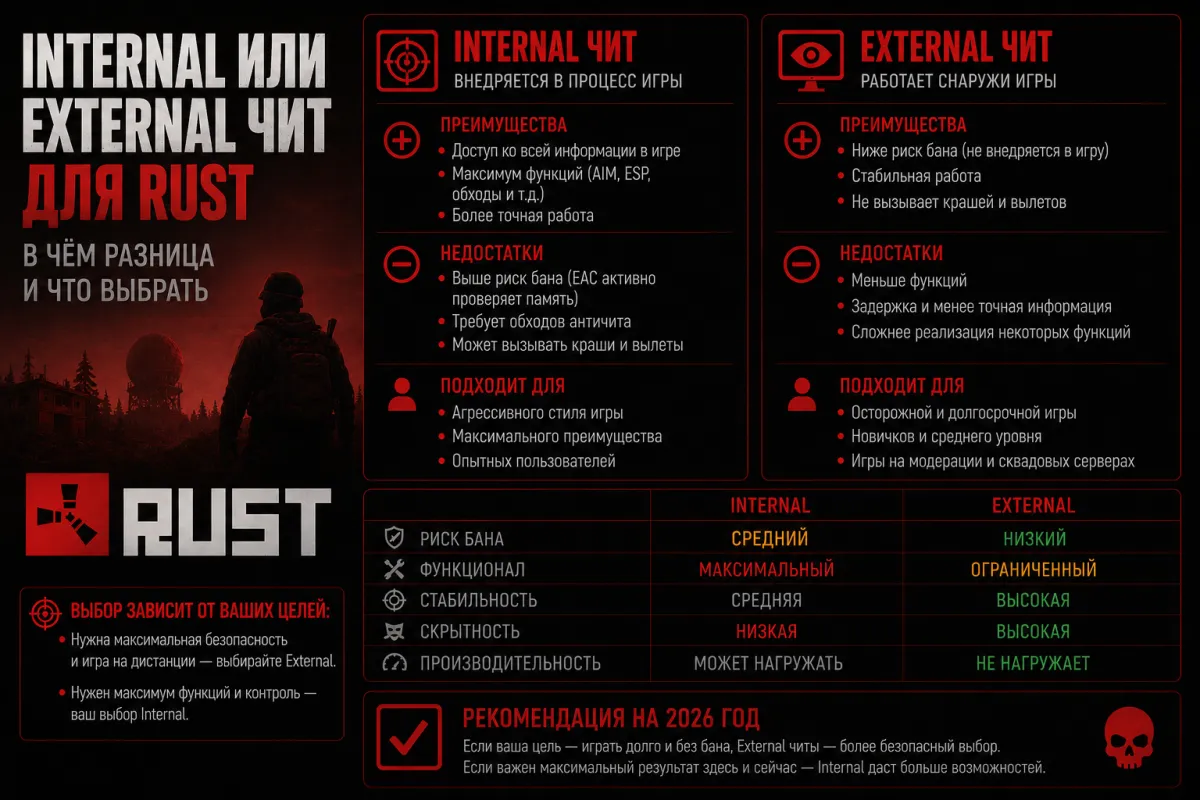
Internal or External Cheat for Rust — What's the Difference and Which to Pick
Internal and External cheats for Rust work differently and fit different goals. We break down the core difference, pros and cons of each approach, and which type to pick in 2026.
How Internal and External cheats work
The fundamental difference between the two cheat types is how they interact with the game process.
An Internal cheat loads directly inside the game process. It works as part of Rust itself, has direct access to memory and renders its own UI from the inside. That's exactly why internal cheats usually have richer functionality: a full aimbot, wallhack, ESP with detailed info, misc functions like spinbot or fast loot.
An External cheat works as a separate program next to the game. It reads the Rust process memory from outside and displays information through an overlay on top of the screen. A typical example — ESP with boxes and player names through a DirectX overlay.
The main thing about safety: the type decides nothing
The most important thing to understand — cheat safety isn't defined by whether it's internal or external. Both types can be equally reliable or equally vulnerable. It all depends on how the developers implemented the EasyAntiCheat bypass.
EAC checks not the "injection type" but specific patterns: code signatures in memory, abnormal process access, suspicious drivers, non-standard hooks. A well-written internal with the right loading method and current bypasses will be completely invisible to the anti-cheat. A poorly written external with obvious memory reads will get banned on day one.
That's exactly why, when picking a cheat for Rust, people look not at the type but at the developer's reputation, the frequency of updates after EAC patches and the current Undetected status.
Functional differences
Even though safety is the same with a quality implementation, the functional capabilities really do differ:
Internal cheats give full access to game data — aimbot, no recoil, silent aim, misc functions. The overlay is drawn from inside the game and looks organic. Good for those who want maximum functionality.
External cheats usually focus on visual info: player ESP, loot, resources. Easier to maintain after game updates — no need to rewrite the injection on every patch. Good for careful play with an information advantage.
How developers ensure safety
Quality private cheats for Rust use several layers of protection regardless of type:
- Current EAC bypasses — developers track every anti-cheat update and adapt loading and memory work methods
- Signature detection protection — the cheat code doesn't contain known EAC patterns, obfuscation is used
- Safe injection — for internal cheats, the process loading method leaves no traces that EAC checks for
- Regular updates — after every Rust or EAC patch the cheat is updated to keep its Undetected status
All cheats on MEMEZ.RU are built with current EAC bypass methods in mind. The status of each product is updated in real time — if a cheat is temporarily down for an update after a patch, it's shown honestly.
What to pick for your goals
Practical recommendation:
- Need full functionality — aimbot, no recoil, misc → Internal cheat. With proper implementation just as safe as external
- Only need visual info, careful play → External cheat. Easier to maintain, same level of safety
- Not sure → look at the status, the date of the last update and reviews of the specific product. That matters more than the type
Do you need a spoofer with a Rust cheat
It's recommended to use a spoofer together with any cheat for Rust — regardless of type. EAC sometimes hands out HWID bans even on the first detection. A spoofer running before the game guarantees the ban won't hit your real hardware — you just generate new data and keep playing.
