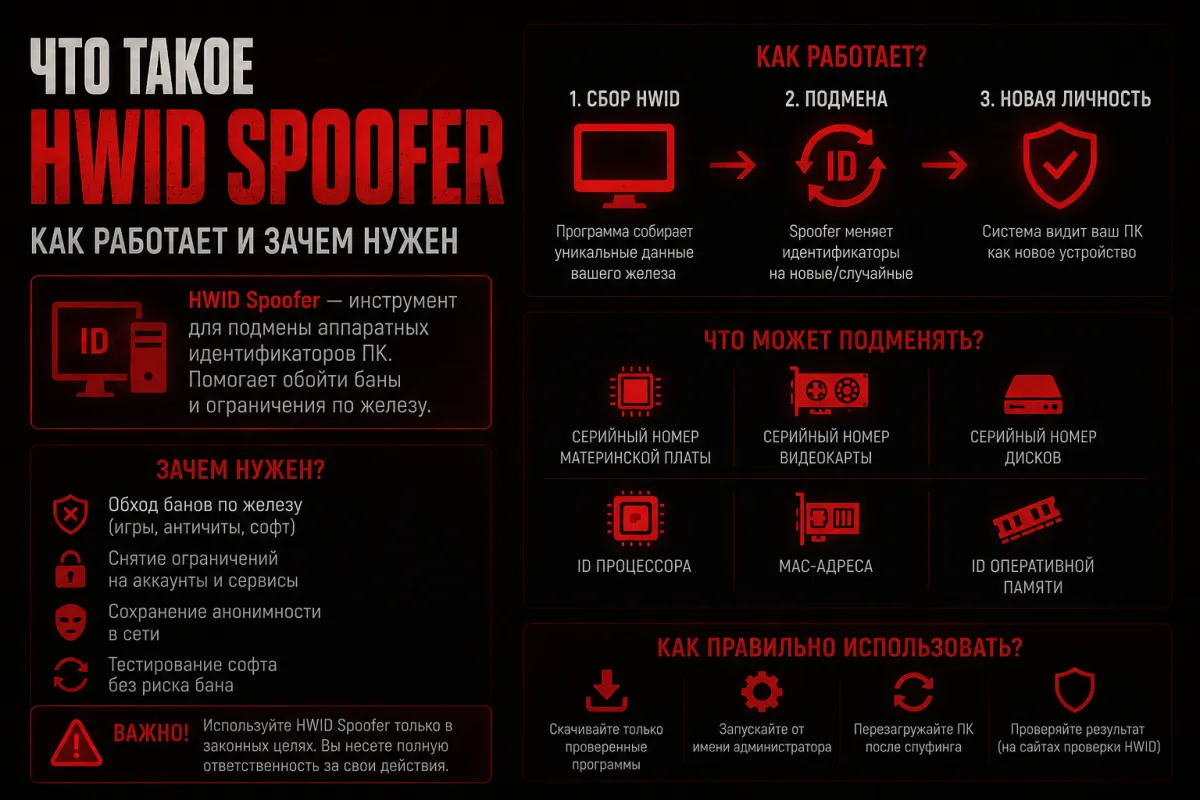
What Is HWID Spoofer — How It Works and Why You Need It
HWID Spoofer is a tool for swapping your PC's hardware identifiers. We explain in plain language how it works, when you need it and how to use it properly.
What HWID is and why you'd swap it
HWID stands for Hardware ID — a unique set of identifiers of your computer. It includes serial numbers of HDDs and SSDs, the motherboard ID, MAC addresses of network cards, CPU identifiers and other hardware parameters.
Modern anti-cheats — EasyAntiCheat, BattlEye, Ricochet — collect this data and store it in their databases. When you get banned, it's not just the account that gets locked but also your HWID. The next time you log into the game from the same computer — even with a new account — the system recognizes your hardware and bans you again.
HWID Spoofer solves this by swapping the identifiers for other values before the game launches. To the anti-cheat you look like a completely different PC.
How a spoofer technically works
A spoofer works at the Windows driver level — this lets it intercept system and game requests to the hardware and return spoofed values instead of real ones. When EAC asks for the drive serial number — it gets a randomly generated value, not the real one.
It's important to understand that a spoofer doesn't change the physical data of your hardware — it only changes what the software sees. After a reboot without the spoofer, all identifiers return to their real values.
Two main usage scenarios
Scenario 1: After getting an HWID ban. You've already got a hardware ban and new accounts get locked instantly. A spoofer lets you keep playing without replacing components or reinstalling Windows. In Rust, Fortnite, DayZ and Dead by Daylight this works without a full system reset — it's enough to disable TPM in the BIOS.
Scenario 2: Prevention. You're using a cheat and want to protect your real hardware. You run the spoofer before the game — if the anti-cheat catches you, it bans the spoofed identifiers. Your real HWID stays clean. Generate new data and keep going.
Which games and anti-cheats are supported
Modern spoofers typically support three main anti-cheats:
- EasyAntiCheat — Rust, Apex Legends, Fortnite, Dead by Daylight, SCUM and many others
- BattlEye — Escape From Tarkov, DayZ, Squad, Arma 3, Rainbow Six Siege
- Ricochet — Call of Duty: Warzone, Modern Warfare 2/3
Important exception: Fortnite's tournament mode has extra checks — a spoofer is not recommended there.
What to do before your first run
Standard checklist before launching the spoofer:
- Disable the TPM module in BIOS/UEFI — this is a mandatory requirement for correct operation
- Run the built-in cleaner — it wipes traces of previous bans from the registry and system folders
- Launch the spoofer and wait for confirmation that the identifiers have been swapped
- Only after that launch the game and the client (Steam, Epic Games, etc.)
The order matters — if you launch the game before the spoofer, the anti-cheat will already have read your real HWID.
